Wednesday, November 27, 2013

The Tradition and Fine Craftsmanship of Lutherie Resonates in New Hampshire

photos courtesy Tim Gaudreau, http://guitar.timgaudreau.com/
New Hampshire is well known for its history of fine craftsmanship and highly skilled artisans. You can hear a variety of live music in the state's cities at least a few nights a week. Depending on the circles you frequent, some of these craft and music traditions are more prominently visable, while and others exert quieter reverberations. As in any music, quiet reverberations can be powerful.

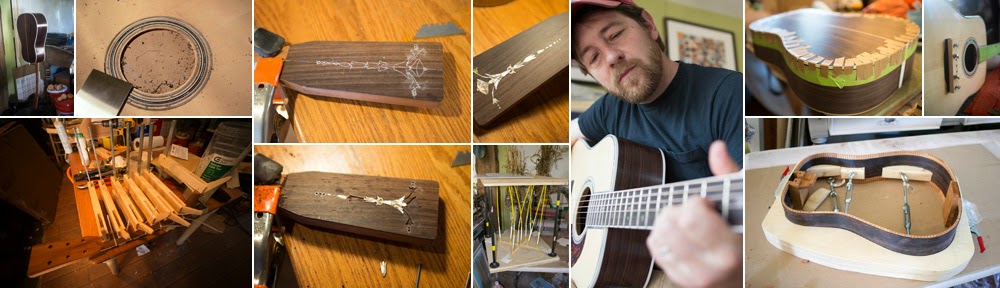
John Whiteside and Tim Gaudreau were awarded a Traditional Arts Apprenticeship Grant in Lutherie, and recently finished their Apprenticeship together. John and Tim belong to a larger statewide group that is interested in this tradition, the Granite State Luthiers Guild. This art and musical form dates thousands of years back to lute making in both Greece and versions of the instrument in India and China.

Tim Gaudreau has been documenting his experience learning Lutherie with John through a blog where he discusses tool building, wood selection, design, inlay, listening, learning, and experimenting. Tim admits that the blog isn't finished, "It's sorely out of date as I have been so busy working on the guitar that I haven't had the time to write about it. I do plan to update this though."

Here is a quote from Tim's blog, but we encourage you to check out his full blog here:
http://guitar.timgaudreau.com/

"John likes to build guitars with a particular sound in mind and he keeps that focus when selecting woods and constructing the instrument. It’s a tricky thing to describe, but with some of the sounds of the songs in our heads, we did some tap tone testing on sample tonewoods to see if we could pick out something that had the same feeling in its sound quality."

Wednesday, November 13, 2013

Concord Multicultural Festival, guest blog by Jessica Fogg

Our first guest blogger is Jessica Fogg of JFogg Social Inspirations. Jessica is Event Chair and Organizer of the Concord Multicultural Festival. She can be reached at www.jfoggsocialinspirations.com
photos taken by Lynn Martin Graton


The 8th Annual Concord Multicultural Festival was held on a perfect fall day, at the State House Plaza on September 28th, 2013. The afternoon was packed with dynamic and engaging performances, delectable cuisines from around the world, fun activities for the kids and the essence of what the event is meant to be about: lots of community spirit.

About 11 years ago, the Greater Concord Area Task Force Against Racism & Intolerance began coordinating community discussions. The 2004 discussion, titled "The Changing Face of Concord: Racial, Ethnic & Cultural Diversity," nearly everyone involved recognized the importance of street festivals to the civic life of Concord, so they decided that a big outdoor party was the ideal way to advance the goals of racial and ethnic tolerance and understanding in our small but quickly changing community. And thus the Concord Multicultural Festival was born!

The mission is to raise local awareness of those newly arriving in our community and appreciation for cultural diversity with the hope that increased awareness, supported by educational programs will inspire our neighbors to accept, welcome and assist the newest members of our community. After all, our ancestors were all immigrants or refugees at one point.

Participants shared and celebrated their native cultures through music, dance, food, crafts, and storytelling. There were 15 different performances ranging from a Chinese Lion Dance, Celtic bagpipes and fiddling, Burundian drumming, Nicaraguan dancing, Indian Carnatic singing, African Dance, Bhutanese Singing, German Classical music, and Nepali Singers. I had a wonderful committee comprised of Unitarian Church members who have a great relationship with the New American communities, staff from Lutheran Social Services (the organization that facilitates the Refugee Resettlement Program), and a few other enthusiastic people who were passionate about organizing the event. We had many local sponsors as well that made the event possible. I was also extremely lucky to have the guidance and support of the past organizers who started the event. - Jessica Fogg

.

Wednesday, November 6, 2013

Alice Ogden, Traditional Black Ash Basket Maker visits with Cynthia Robinson's 5th & 6th grade at Madison Elementary School

As part of the 2013 Arts in Education Partnership Conference, the NH State Council on the Arts partnered with the Arts Alliance of Northern New Hampshire and Madison Elementary School to bring traditional black ash basket maker Alice Ogden to Madison Elementary for a one day artist visit with 5th and 6th grade students.

Alice brought in many examples of baskets she's made, tools, and even a black ash log to demonstrate how the growth rings are split from the tree to make different baskets for different functions. Students worked with Alice and art teacher, Cynthia Robinson to weave a tree star. This artist visit complements many of the other units Cynthia does with her students, placing a high value on respecting and creating art with natural materials.

Through cultural artistic traditions and skills students learn about other cultures as well as their own. They develop empathy and understanding for the expressions of other cultures as well as reaffirm what makes their own community unique. Learning connections beyond the school day and for lifelong learning are fostered by having a traditional artist in the classroom.Sharing the cultural and artistic traditions of a community offers many opportunities for youth to engage in hands on experiential learning and make connections to their culture and heritage. These connections can be used to support the curriculum of many subjects including social studies, history, citizenship, earth science, english language arts, mathematics, and of course the visual arts, music, dance and theatre.

Listen to Cynthia and Alice discuss the importance of artist visits to the classroom:

Tuesday, October 1, 2013

Interview with Master Guqin player Shin-Yi Yang and apprentice Adam Kale

The NH State Council on the Arts has been funding Master and Apprentice Traditional Arts teams since 1995, providing support for over 35 art forms. The grant helps to support a master traditional artist and an experienced apprentice in one-to one sessions for a six to ten month period.The teaching and learning usually take place in homes- around a kitchen table, in a garage or workshop. Their work is rooted in the community and the success of these grants is based on trust and respect.

At the conclusion of a Traditional Arts Apprenticeship, State Arts Council staff visit many of the grantees to conduct audio interviews and take photographs in order to document the project, provide an archive for those interested in state culture and history, and to share with the wider public (Graton, 8).

On September 29, 2013 Julianne Morse interviewed master guqin player (pronounced goo-chin) Shin-Yi Yang and her apprentice, Adam Kale. The guqin is a seven stringed zither, and is one of the oldest Chinese instruments dating to over 3000 years ago. In 2003 UNESCO designated the guqin as as a piece of Oral and Intangible Hertiage of Humanity. In the video below you can listen to both Shin-Yi and Adam talk about how they came to learn the instrument, its importance to both Chinese culture and heritage, and how it is informing the cultural landscape of New England.


interview with Shin-Yi Yang & Adam Kale from Julianne Morse on Vimeo.


Graton, Lynn (Ed.). (2012). Shaping Our Heritage. Concord, NH: New Hampshire State Council on the Arts. Print.

Tuesday, September 3, 2013

Harvesting fibers in New Hampshire

Details of in process weaving by Diane Homes

Antique hand carved shuttles
Heckling, retting, swingling, breaking, spinning and weaving- hang out with the Flax Girls and these are some of the things you’re in for.

Gina Gerhard moved to NH as a young girl from NY and soon took up fiber arts as a way to pass the winter months. As a girl she thought, “wool is boring, I want to do something different." Piecing together information from craft books, journals, and store ledgers she taught herself how to process flax including harvesting, retting, drying, breaking, swingling, heckling and eventually spinning and weaving. Gina is now very knowledgeable about the process, the tools, and the history of this art form that was essential to New England farm life prior to the invention of the cotton gin. Despite all of her research however she would tell you that there are only so many things you can learn from a book. Most written accounts and instructions assume a degree of familiarity with the flax crop and the process of turning it into a fiber. Some steps you need to learn by repeated experience – like how brown and moldy should your flax look when it is ready to stop the retting process? Why is retting flax in a pond more efficient than dew retting? Just how hard to you have to whack the flax when you’re swingling it?


Cathy Goodmen spinning 
flax fiber into linen thread

Gina was joined by two other dedicated fiber artists from New Hampshire, Cathy Goodmen a spinner and dyer from Franklin, and Diane Howes a Master weaver from Danville. The women jokingly refer to themselves as the “Flax Girls” as they have been demonstrating together across the state for years. Gina prepares the flax from straw to fiber, Cathy spins the fiber into thread, and Cathy was nearby weaving checked linen towels on an antique 4 shaft counterbalance loom. All three women were deeply interested not only in the process of working with the fiber but also the craftsmanship and history of the handmade tools. The flax to fiber process can be traced to the middle ages, and Gina highlighted how the tools are the distillation of hundreds of years of refinement. That’s not exactly the first thought you might have when looking at the wrought iron spikes sticking up from a board to form the heckle, or comb used to thin the flax. On Diane’s antique loom, there are 516 hand tied string heddles which have been replaced by metal on more modern looms. “This loom is so quiet”, Diane and Cathy both remarked. There was no metal slamming up and down only hand tied string knots, and hand carved wooden shuttles. Processing and weaving of flax by the individual New England family declined with the popularization of mills like those in Exeter, Meredith, and Manchester. 


Gina Gerhard demonstrating the flax to fiber process. Flax is still grown near the site of the retting pond in Gilmanton, NH


The demonstration took place in Gilmanton near one of the only known flax retting ponds in New Hampshire. The pond has been undergoing restoration by the Gilmanton Historical Society, and the organization has invited Gina, Cathy, and Diane to demonstrate at the pond for the past two years. The flax retting pond is man made with the bottom lined with rocks so the flax could be laid out on the rocks, and then weighted down with clumps of sod to prevent the straw from floating to the surface. The natural microorganisms in the pond create the perfect environment for a retting process that can take 4-6 days- which is much quicker than the month it usually takes for dew retting out in a field.  The land has recently been purchased with community donations to the Gilmanton Land Trust, and will be placed in conservation permanently with the town.